Put AI to Work in Everyday Manufacturing.

Specialized agents. Workflows tailored to your plant.
Start with specialized agents. Extend their reach through configurable workflows.



In Practice
See how SICK uses the Shopfloor Agent to support production troubleshooting.

Why Bosch?
Manufacturing experience meets Industrial Grade AI.
A successful test run is only the beginning. Bringing a machine into daily production requires defined operating limits, monitoring, and maintenance. AI agents need the same operational discipline.
Bosch brings experience from its own manufacturing environments to an Industrial Grade approach focused on four areas:
- Input & Output Guardrails
Input checks help detect manipulation attempts in requests and retrieved content. Output checks assess generated responses against defined policies, helping reduce inappropriate instructions and unintended disclosure of information.
- Agent Harness & Controlled Actions
The Agent Harness is the control layer around an agent’s execution. Its role is to apply scoped permissions and rules for tool use, and to define how execution handles failures.
- Traceability & Human Oversight
Audit records and configuration histories support investigation of actions and changes. Defined responsibilities and approval points establish when a person must decide before an action proceeds.
- Monitoring & Continuous Evaluation
Operational monitoring tracks availability, execution failures, and resource usage. Repeated evaluations assess answer and action quality as models, data, and workflows change.
Build vs Buy
Look beyond the first agent.
An AI prototype is only part of the investment. Daily operation brings ongoing responsibilities: integration, security, monitoring, quality checks, updates, and support.
The economic question is how much of that foundation your team wants to build and maintain itself.
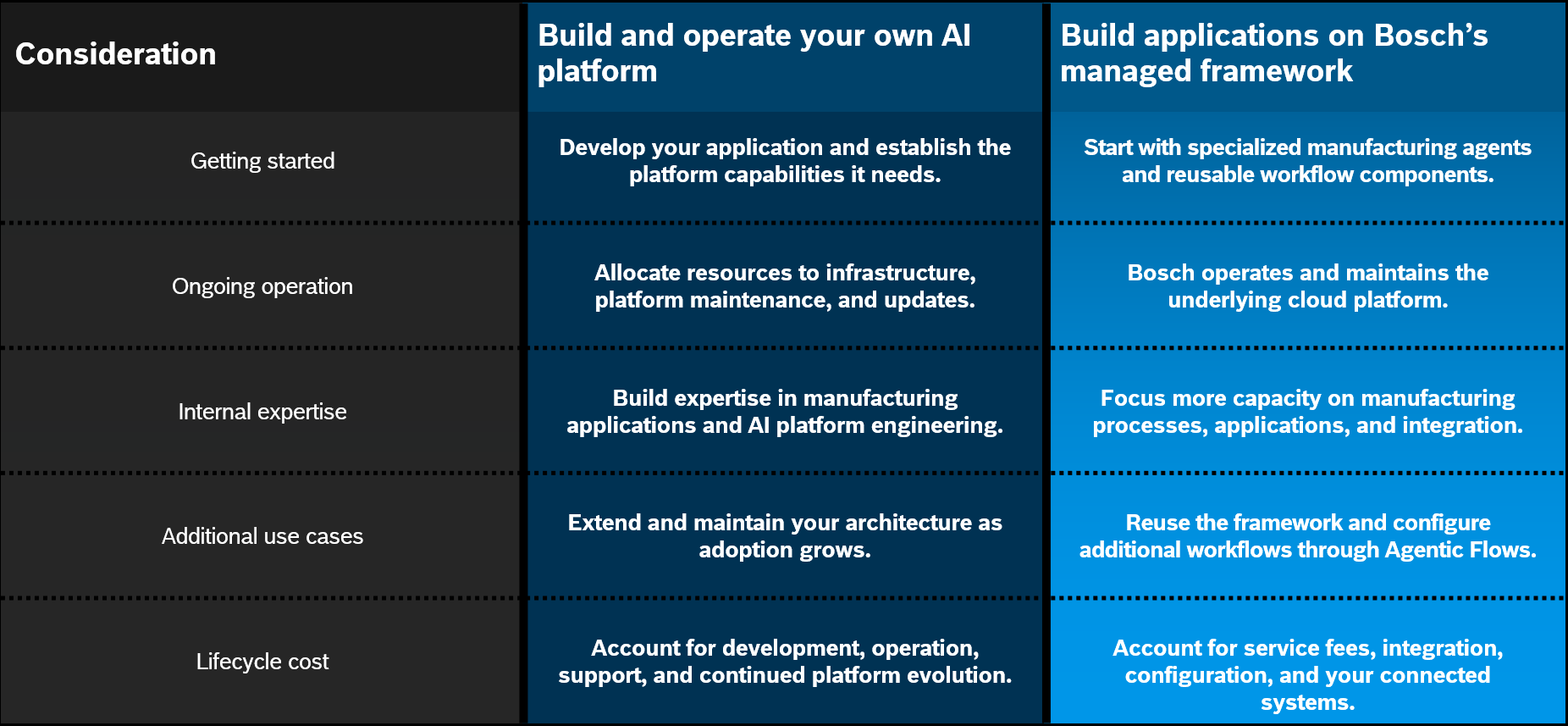
Focus your development on your manufacturing processes.
Use Agentic Flows to configure applications around your needs while Bosch operates the underlying platform. Compare the full lifecycle cost, including service fees, integration, connected systems, and ongoing operation.
Start with a manufacturing challenge.
Discuss your use case, relevant data sources, and existing systems with our team.
