Sustainability through transparency

With the Bosch Battery Passport, you comply with EU battery regulations through complete transparency across your batteries' lifecycle – the digital twin solution supports regulatory compliance while forming the foundation for numerous additional value-creating applications.
Battery Passport countdown: Ready for 2027?
Starting 2027, EU regulations will mandate a digital battery passport for all batteries placed or put into service on the EU market. This includes electric vehicle batteries, light means of transport batteries, and industrial batteries with a capacity of 2kWh or more.


Frequently asked questions about the Battery Passport
What is the EU Battery Passport?
The EU Battery Passport is a digital record for an individual battery, required by EU Battery Regulation (EU) 2023/1542. It makes lifecycle information — material composition, carbon footprint, performance and end-of-life data — available to defined stakeholder groups through a unique identifier. It becomes mandatory on 18 February 2027.
When does the Battery Passport become mandatory?
On 18 February 2027. From that date, a Battery Passport is a mandatory condition for placing new batteries on the EU market under EU Battery Regulation (EU) 2023/1542. Because passport data has to be gathered across the supply chain and across a battery's life cycle, preparation needs to start well before the deadline.
Which batteries require a Battery Passport?
Three categories: electric vehicle batteries, light means of transport (LMT) batteries, and industrial batteries. For electric vehicles, the passport is mandatory for batteries powering hybrid or fully electric vehicles of classes M, N and O, and for class L vehicles such as electric motorcycles where the battery alone exceeds 25 kg. Starter batteries (SLI) are excluded.
Do e-bike and e-scooter batteries need a Battery Passport?
Yes, if the battery weighs more than 5 kg. E-bikes, e-scooters and comparable personal electric vehicles fall under the light means of transport (LMT) category, which covers batteries above 5 kg and up to 25 kg. Batteries below 5 kg are outside the current scope.
Do industrial batteries need a Battery Passport?
Yes, for industrial batteries weighing more than 5 kg. This includes batteries specifically designed for industrial purposes and batteries prepared for industrial reuse, known as second life. Only LMT, EV and starter batteries (SLI) are explicitly excluded from this category.
Who is responsible for creating the Battery Passport?
The economic operator that first places the battery on the EU market, or puts it into service for its own use. That party is responsible for creating the passport and for the accuracy and completeness of its data. Bosch provides the platform and the automated data foundation; the regulatory responsibility stays with the economic operator.
Are importers and device manufacturers also responsible?
Yes. Importers bringing batteries into the EU are legally treated as manufacturers and carry full responsibility for the Battery Passport. Device manufacturers must provide the passport where they are the first to place the battery on the market themselves.
What happens if a battery has no Battery Passport?
From 18 February 2027, a battery without a valid passport cannot lawfully be placed on the EU market. Consequences include sales bans, withdrawal of non-compliant batteries from the market, and civil claims for damages. In Germany, § 29 of the Battery Act (BattG) provides for fines of up to €100,000 per individual case.
Which standards does the Bosch Battery Passport use?
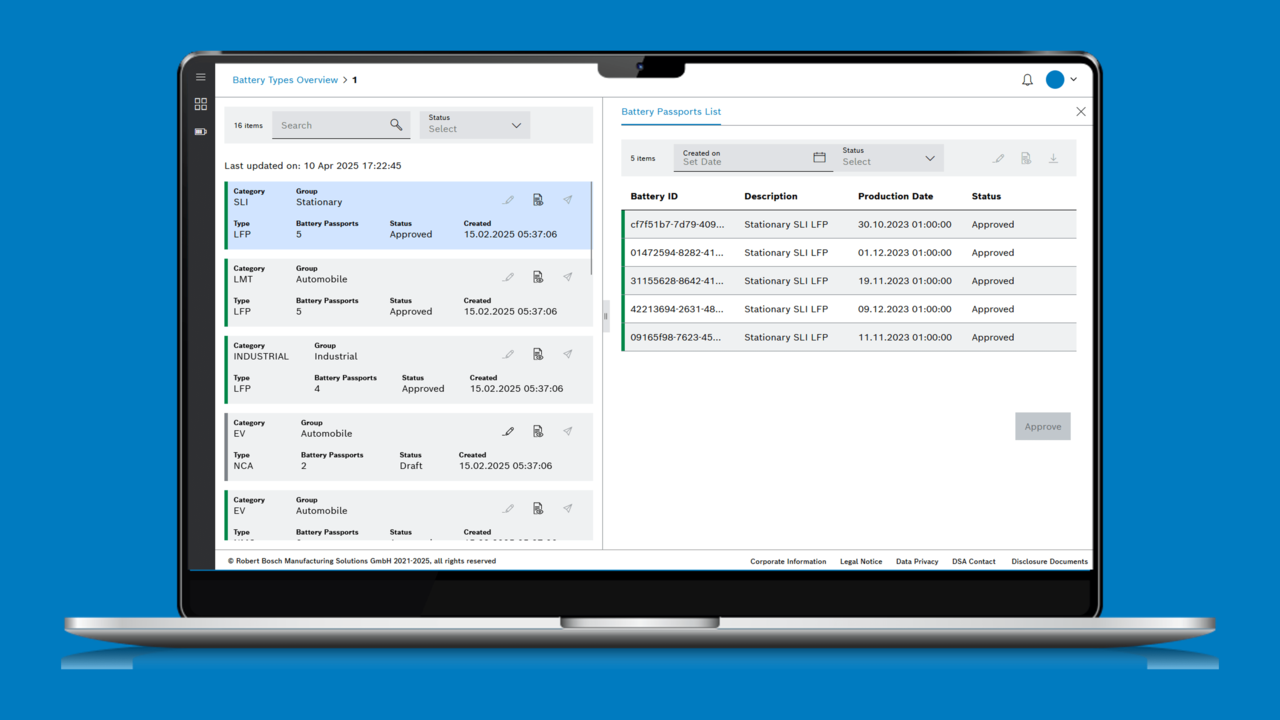
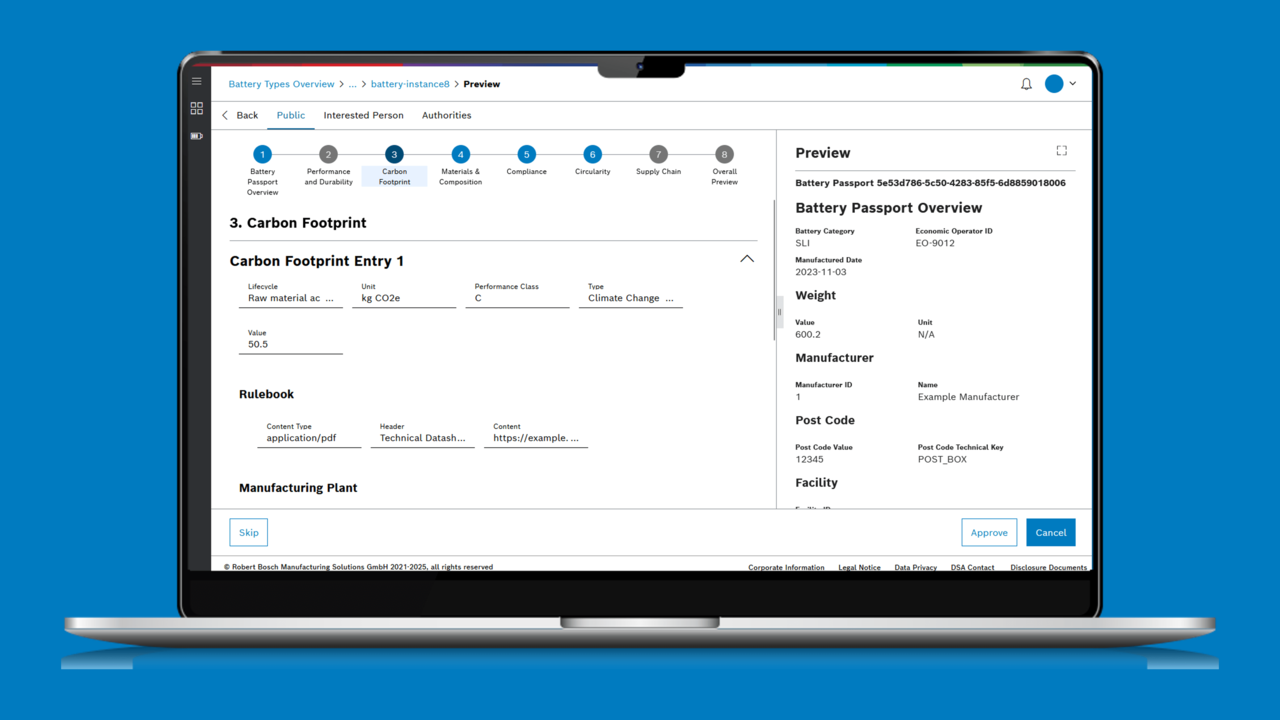
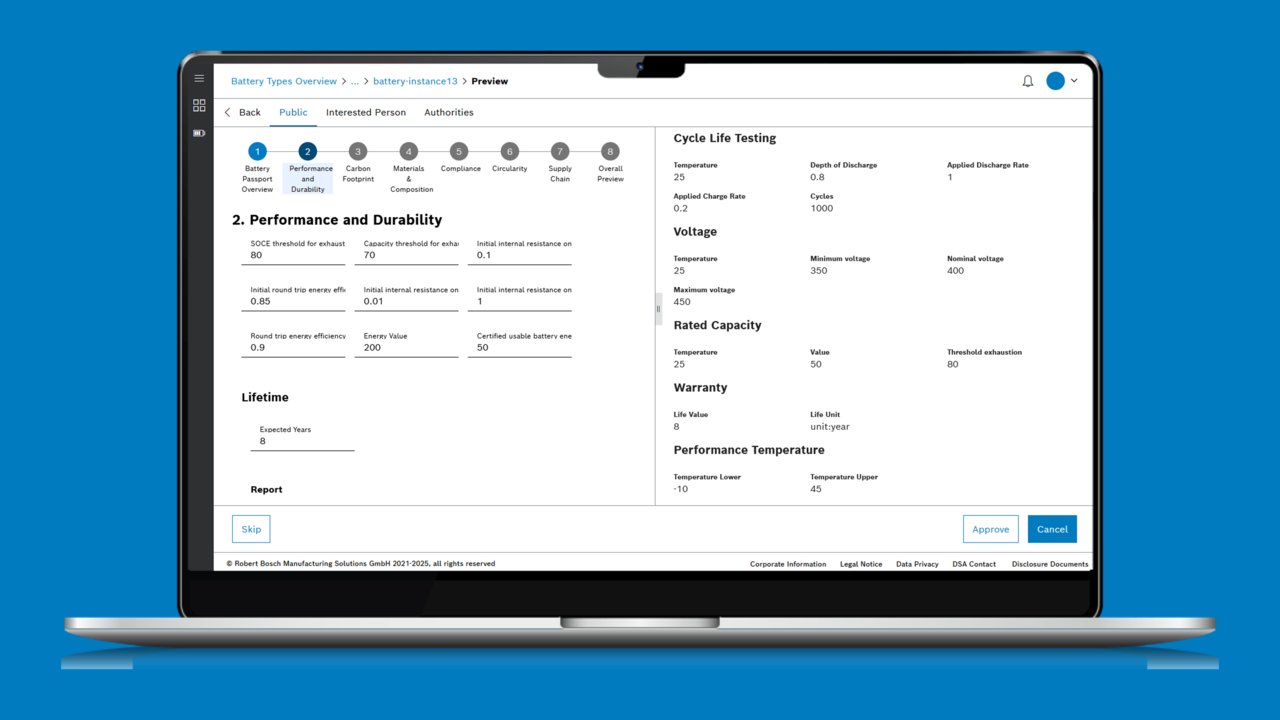
The Bosch Battery Passport creates a digital twin for each individual battery on the open IDTA Asset Administration Shell (AAS) standard, generated automatically through an ETL pipeline and registered in a Catena-X certified Digital Twin Registry. Passport data can be retrieved via APIs with push and pull services, and through a user interface.
Who can see which data in the Battery Passport?
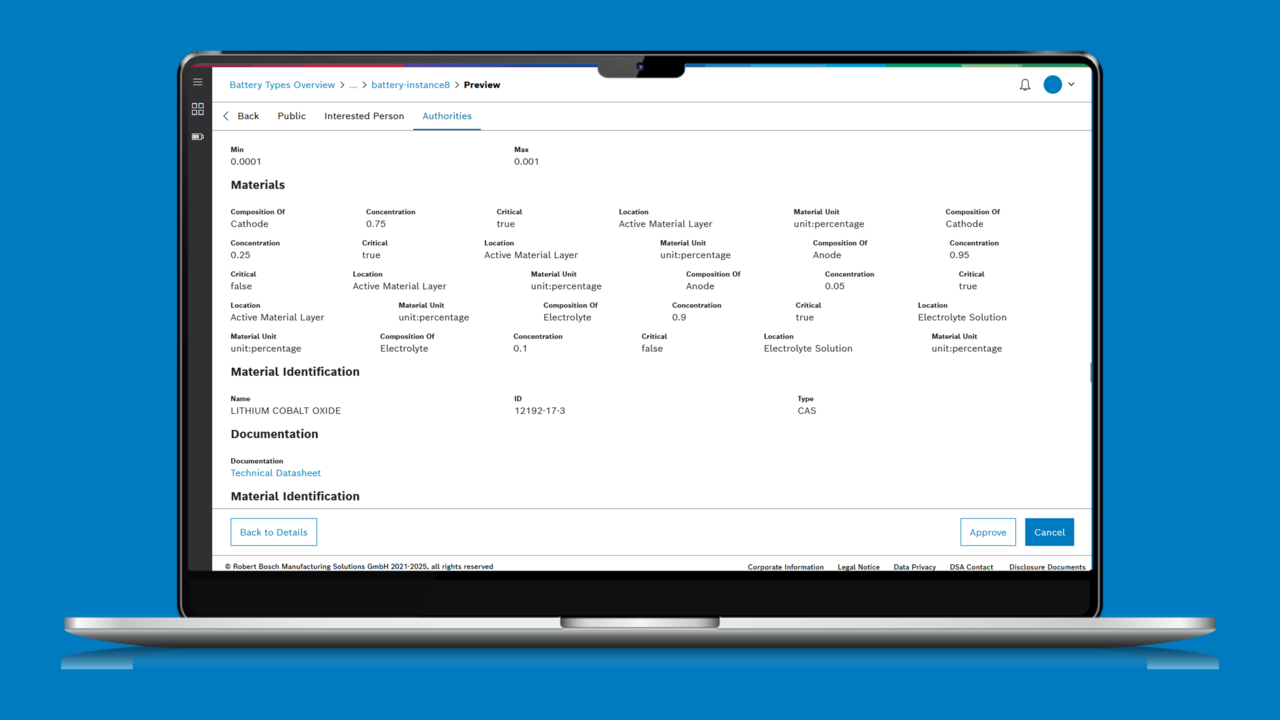
Access is differentiated by stakeholder group. Passports are generated for the general public, interested parties and authorities, and each group sees only the data relevant to it. A complete review and approval process covers all battery data before publication, and the decentralized architecture keeps your own data under your control.
