Rising energy costs, geopolitical volatility, and an inevitable labor shortage caused by the retirement of an entire generation – the global manufacturing industry is under unprecedented transformational pressure. In this challenging environment, industrial decision-makers are searching for leverage to radically increase the efficiency of their value chains. Artificial intelligence and data-driven architectures often promise to be the ultimate breakthrough.
Yet, reality on the shop floor reveals a deep discrepancy: manufacturers are collecting more data than ever, but they cannot use it effectively. While the volume of industrial data captured worldwide is exploding exponentially, the business value generated from it is stagnating at the same rate. This phenomenon is the Data Growth Paradox – the data growth dilemma of modern manufacturers.
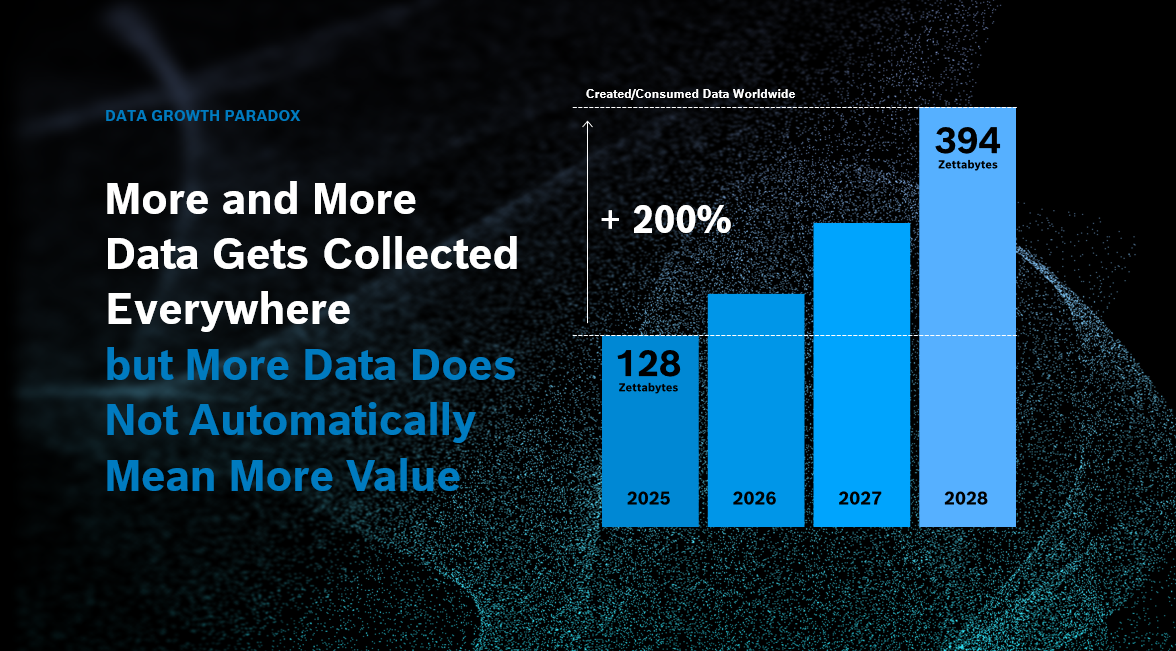
To unlock the full potential of Industry 4.0 and artificial intelligence, organizations must bridge the gap between unstructured raw data and contextualized, cross-departmental knowledge.
The Root of the Problem: The Chaos of Point-to-Point Silos
Infrastructures do not scale through isolated point solutions, but through standardized, reusable data structures.
Why do so many ambitious digitization projects and AI pilots fail when transitioning into regular series production? The answer lies in the fragmentation of the industrial systems landscape. A physical product passes through highly isolated data worlds during its lifecycle: from CAD drawings and text-based specifications in engineering (As Engineered), to MES and testbench data in manufacturing (As Produced), all the way to telemetry and diagnostic values from the customer in the field (As Operated).
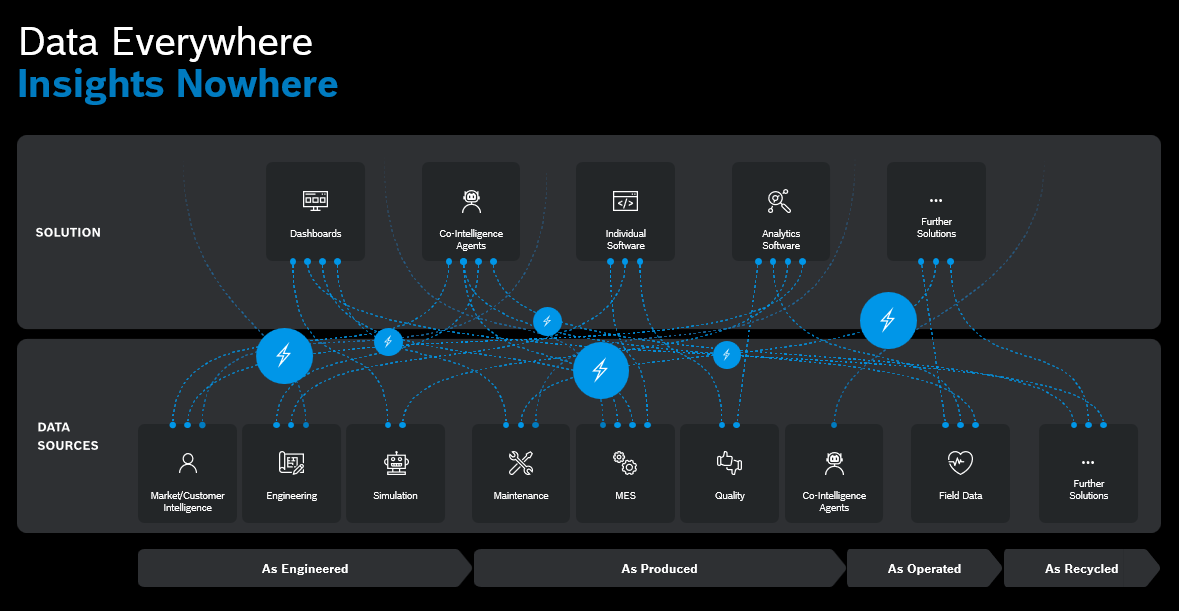
Because this data resides in technologically segregated IT silos, dedicated departments resort to digital self-help. The quality manager builds a custom, proprietary interface to link MES data with field data. Shortly after, the maintenance team develops its own point-to-point connection for a new predictive maintenance tool.
The result is an untangleable, rigid web of proprietary point-to-point data integrations. These interfaces are extremely expensive to maintain, inflexible to system changes, and virtually useless for other departments. They slow down the organization, consume valuable IT resources, and prevent any systematic scaling of AI applications across different factories.
The Architectural Answer: Integrate Once, Use Endlessly
The transformation from raw signal to business-critical context follows a clear principle: Integrate once, use endlessly.
Escaping this integration chaos requires a paradigm shift in data architecture. Instead of linking data individually and in isolation for every new use case, data streams must be imbued with universal meaning from the outset. This is achieved by implementing a Semantic Stack – a structured layer that establishes a shared understanding of data.
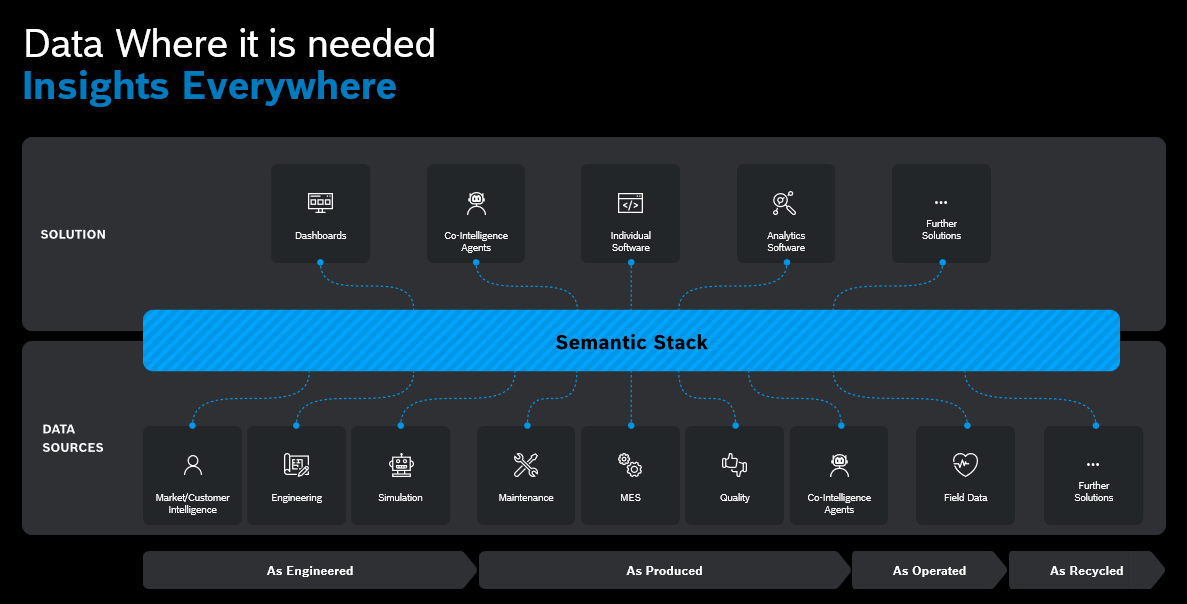
A raw data value like "117" is useless in isolation. A semantic model first gives it a clear physical meaning: it is a temperature, measured in degrees Celsius.
The decisive architectural step, however, is contextualization: Where exactly was this temperature measured? At what time? What other process parameters occurred simultaneously, and which specific component does this value belong to across all lifecycle phases? Only this semantic link brings raw data to life, making it machine-readable and usable across departments. Data becomes a reusable asset, ready for any future application.
The Digital Twin as a Lever for Industrial Scaling
Proof that this semantic approach is not just theoretical computer science is demonstrated daily across high-volume manufacturing networks. By systematically leveraging a semantic data foundation, Digital Twins can be realized at an industrial scale – representing a virtual model of every manufactured and active field product. Bosch has already successfully established over 700 million Digital Twins using this method.
This standardized structure allows entirely new, cross-lifecycle correlations to be uncovered instantly. For example, if a specific error code occurs in the field, the Digital Twin can immediately correlate it with exact parameters – such as the aforementioned process temperature of 117 °C – during that specific manufacturing step in the plant.
Insights that were previously buried behind the complexity of rigid legacy systems and the massive effort of manual data preparation suddenly become accessible in real-time.
The Catalyst for Agentic AI: Why Agents Need Semantics to Act
Industrial AI is rapidly evolving from passive chatbots into active, autonomous agents. However, an agent is only as capable as the interfaces it is given.
When modern AI agents or Large Language Models (LLMs) access unstructured data lakes, they quickly hit their limits. In the zero tolerance environment of a factory floor, hallucinations in AI models present an incalculable risk to both humans and machines. To provide reliable diagnoses, an AI agent does not need mountains of unstructured data. It needs actionable context.
Semantic data models (e.g., based on the Asset Administration Shell) act as the AI’s navigation system. They translate the physical factory world into a shared, machine readable language and give every data point a defined meaning. Once this data is harmonized and linked to digital twins, the AI agent no longer has to “guess” blindly. It navigates along clearly defined relationships and instantly understands which machine is linked to which sensor and which control commands are valid.
The result: Utilizing this semantic foundation makes AI tools up to three times more accurate. What’s more, it creates the basis for a safe transition from pure assistance to autonomous, closed loop AI. The agent no longer just analyzes a problem; protected by semantic guardrails, it can recommend and, where approved, initiate the appropriate corrective action in the control system.
Measurable Business Impact: Efficiency Gains at the Executive Level
The systematic transition from project-based data silos to a semantic data architecture is not merely a technical modernization. It is a strategic lever to significantly lower operating costs across the entire value chain:
- Sustainable reduction of data provisioning costs by up to 70 percent: Because data is semantically prepared only once and is then highly reusable, the cost and time-to-market for all subsequent projects drop drastically.
- Reduction of coordination effort by up to 90 percent: A unified, machine-readable understanding of data eliminates tedious alignment meetings and translation errors between engineering, quality management, and individual manufacturing plants.
- Lowering warranty and guarantee costs by up to 30 percent: By seamlessly linking field and production data, quality defects can be resolved immediately at the source before expensive series defects occur.
Conclusion: The Path to Manufacturing Co-Intelligence
The era of uncoordinated data hoarding and isolated proof-of-concepts is over. Economic success in the coming decade will not belong to companies that pile up the largest mountains of data or pilot the highest number of isolated chatbots.
The key lies in mastering the Semantic Data Layer. It forms the foundation for true Manufacturing Co-Intelligence – a collaborative production system where humans and artificial intelligence work together based on a single, trusted source of truth. Only when we give data context do we transform the Data Growth Paradox into a durable, scalable competitive advantage in the global market.
Interested in solving the Data Growth Paradox?
Watch our presentation on overcoming the Data Growth Paradox in manufacturing. The video provides practical insights and real-world examples on how semantic data models break down integration silos and turn raw shop floor data into scalable business value.