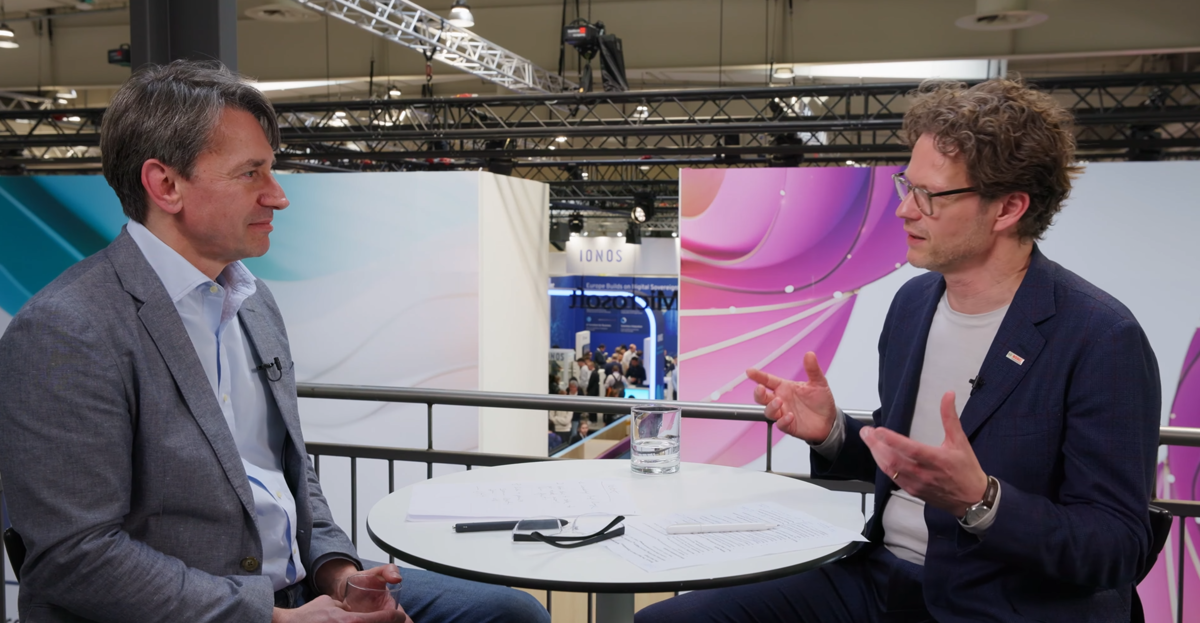
Norbert Jung recently joined Microsoft's New Industrialists series to talk about Agentic AI in manufacturing, from the early decision to invest in it two years ago to the pattern behind why, according to the MIT NANDA study, 95% of AI initiatives still don't deliver measurable return. We're sharing the conversation here and pulling out the main points for anyone who doesn't have 30 minutes to watch it in full.

Not human or machine, but both
A recurring point in the conversation is that Agentic AI should expand what people on the shopfloor can do, not replace them. The "lights-out factory" comes up as an idea that gets attention but isn't the near-term reality for most manufacturing environments, which are too diverse for full automation to make sense everywhere. The more immediate opportunity sits in support functions such as planning, quality and maintenance, where agents can take over some of the manual workarounds that currently hold processes together.
That is the reasoning behind Manufacturing Co-Intelligence®: humans AND machines AND Agentic AI working on the same problem, not one replacing the other.
Why projects stall
One point Jung makes is that many Agentic AI projects start with the technology rather than the business problem: a team deploys an agent because the capability exists, without first defining which KPI it is meant to move. A single agent addressing one step in a process also isn't enough on its own. It takes a system that covers the process end to end and can be applied across plants and lines to actually show up in the numbers.
The other factor is data. Agents can only work with what the underlying systems give them, and most industrial data isn't connected in a way that carries shared meaning across departments. More data volume doesn't solve that. Without a semantic layer connecting the data, integration work has to be redone for every new use case.
Where it shows up in practice
Two examples from the conversation: on the shopfloor, an agent can support experts in resolving unplanned downtime even outside expert working hours, which matters given how much production time is lost between a night-shift issue and the next morning. In quality management, root cause analysis is often skipped because it means pulling data from too many disconnected systems by hand. An agent that can read the semantic context across those systems can complete that analysis in a fraction of the time.
Bosch groups this work into what it calls Performance Domains: recurring, well-defined problem areas rather than one-off use cases, built on production knowledge validated inside Bosch's own plants before being applied elsewhere.
Real improvement doesn't happen at a single point. It scales from shopfloor to value chain.