It is late on a Friday evening. A critical production line suddenly stops. The maintenance expert has already left for the weekend, documentation is scattered across different systems, and every minute of downtime increases production losses.
Situations like this occur every day in manufacturing plants around the world. They also illustrate why AI agents are quickly becoming one of the most promising technologies for industrial operations.
By helping operators analyze incidents, guiding troubleshooting, documenting successful solutions, and making expert knowledge available whenever it is needed, AI agents can significantly improve equipment availability and operational efficiency.
As organizations begin exploring this technology, one question repeatedly arises.
Should we build our own AI agent or buy a solution that is already designed for manufacturing?
At first glance, building appears to be the obvious choice. Modern AI models are widely available, development frameworks are evolving rapidly, and experienced software teams can create impressive prototypes within only a few weeks.
However, a successful prototype is only the beginning. The real challenge starts when an AI solution has to operate reliably in a production environment every day.
When companies evaluate the complete business case, the economics often look very different.
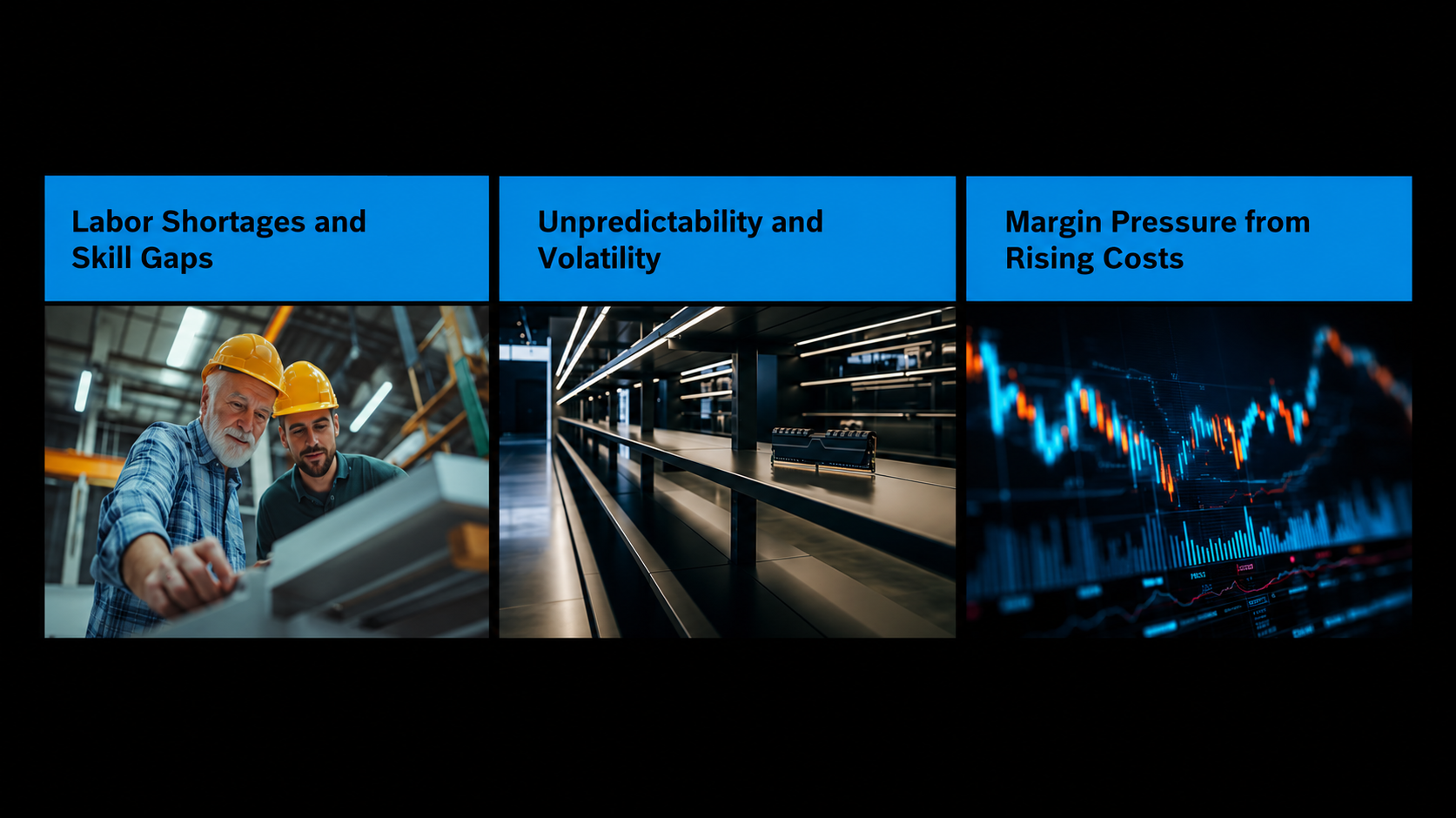
Manufacturing Challenges
Introduce the business context with the three major challenges manufacturers face today: rising costs, supply chain volatility, and labor shortages.
AI Agents Turn Knowledge into Business Value
Manufacturers are operating in an increasingly demanding environment. Rising energy, material, and labor costs continue to reduce margins. Supply chains remain unpredictable, while experienced operators and maintenance specialists are becoming more difficult to recruit and retain.
One challenge has a particularly strong impact on productivity and profitability.
Unplanned downtime.
Every unexpected machine failure interrupts production, delays customer deliveries, and requires valuable engineering resources. During night shifts or weekends, the right expert is often unavailable. Critical knowledge may exist only in personal experience or fragmented documentation, making it difficult to access when every minute counts.
AI agents address exactly this challenge.
An AI powered shopfloor assistant gives operators immediate access to the collective knowledge of the organization. It can recommend troubleshooting steps, translate technical information into different languages, automatically document successful solutions, and continuously improve through every resolved incident.
The result is faster problem solving, shorter production interruptions, and more consistent operations across plants.
Based on Bosch customer projects, a typical manufacturing plant can save up to €850,000 per year by reducing downtime and accelerating problem resolution. Actual savings depend on plant size and operational maturity, but the business potential is substantial.
The opportunity is no longer whether AI creates value. The real question is how companies can realize that value as quickly and efficiently as possible.
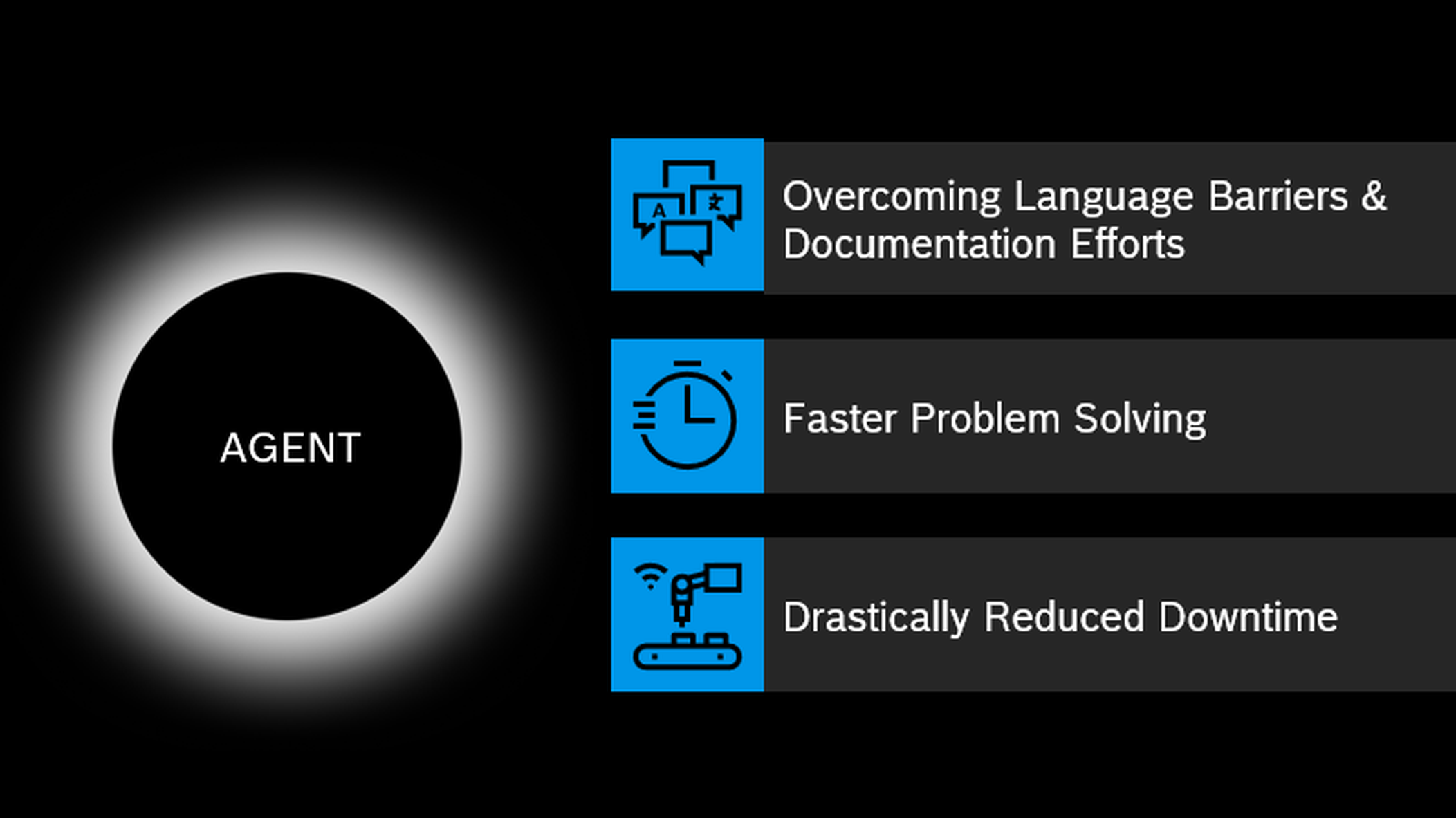
AI Agent for Analysis and Documentation
Illustrate how an AI agent supports operators by reducing downtime, accelerating troubleshooting, overcoming language barriers, and documenting solutions.
Building an AI Agent Is Easier Than Running One
Most organizations initially reach the same conclusion.
“We can build this ourselves.”
Technically, that assumption is correct.
Today’s AI technologies allow experienced development teams to create an impressive proof of concept within a relatively short period of time. A successful pilot can demonstrate the technical feasibility of an AI solution and generate enthusiasm across the organization.
However, a prototype answers only one question.
Can we build it?
It does not answer the much more important question.
Can we operate it successfully?
Once an AI solution becomes part of daily production, entirely new requirements emerge. Cybersecurity must be maintained, user access has to be managed, models require continuous monitoring, compliance standards evolve, and the solution needs to scale across production lines and manufacturing sites. Around the clock support becomes essential because production rarely stops.
These operational requirements determine the long term success of an AI initiative far more than the initial development effort.
Beyond operational complexity, companies should also consider the hidden economics of building their own platform. Continuous maintenance, infrastructure updates, governance, specialized AI expertise, and ongoing support all contribute to the Total Cost of Ownership. In addition, every month spent developing an internal solution delays the operational improvements that AI could already be delivering.
Looking only at implementation costs provides an incomplete picture. A realistic business case considers the entire lifecycle of the solution.
Time to Value Is a Competitive Advantage
Technology investments should not only be evaluated by implementation cost. They should also be measured by how quickly they begin creating business value.
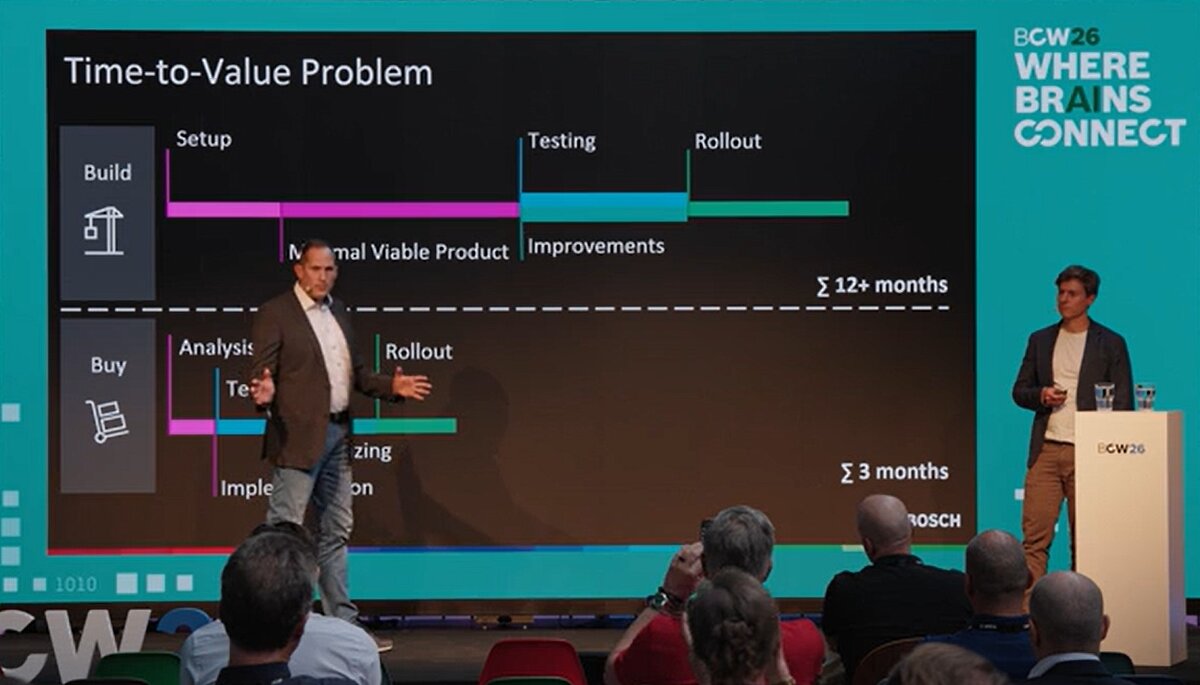
Developing an enterprise ready AI platform often requires twelve months or more before it can be deployed across multiple production environments.
Purpose built manufacturing AI solutions can frequently be implemented within only a few weeks.
That difference has a direct financial impact.
Earlier deployment means earlier productivity gains, faster organizational learning, and earlier opportunities to scale successful use cases across the enterprise.
While one organization is still developing its platform, another is already improving production performance and generating measurable returns.
In manufacturing, speed creates competitive advantage.
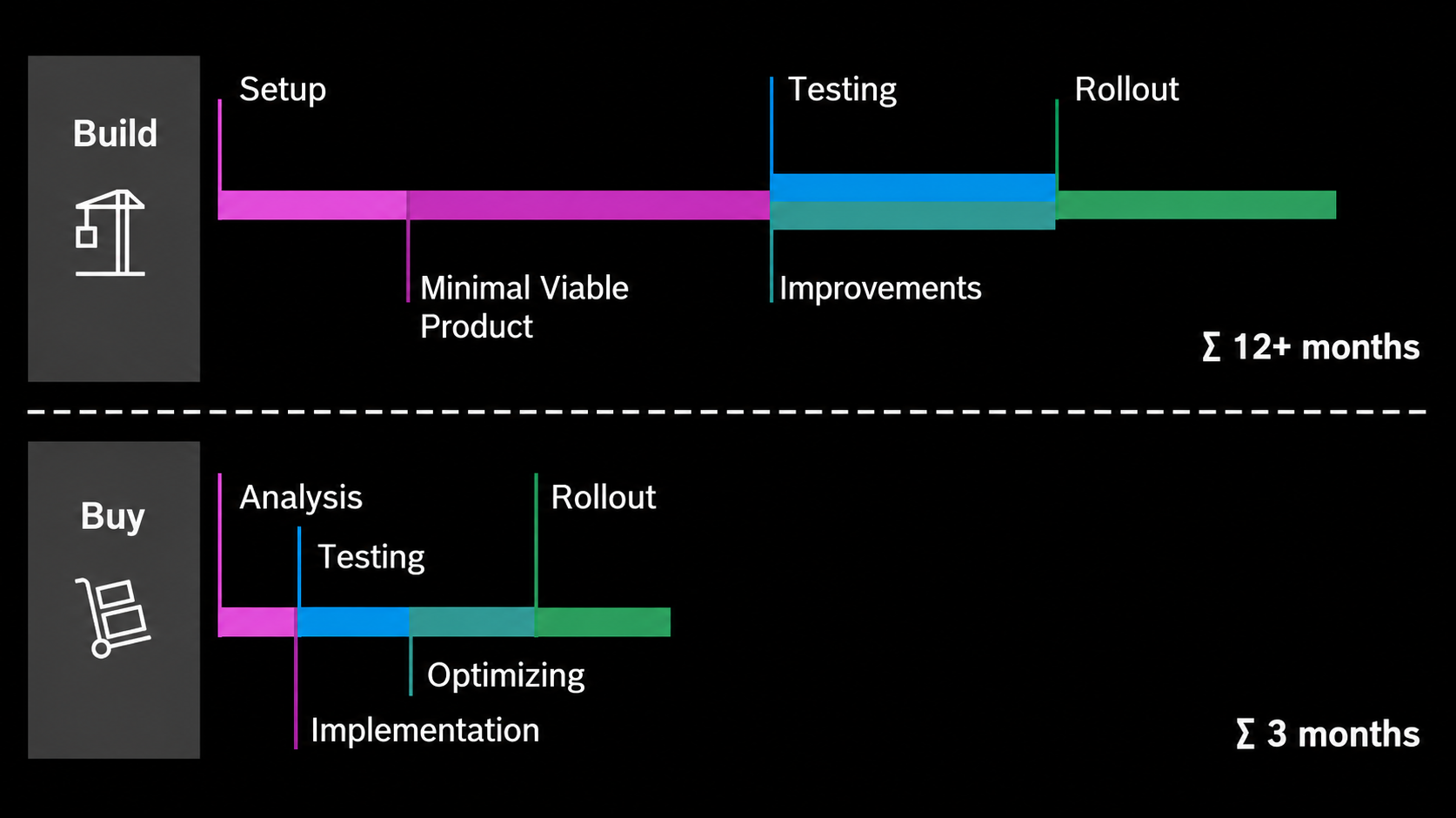
Time to Value Comparison
Compare the implementation timeline of Build versus Buy to illustrate how earlier deployment accelerates business value.
The Better Business Case
Many decision makers assume that custom developed software automatically creates greater value because it is tailored to their own processes.
In practice, purpose built manufacturing AI platforms often deliver stronger business outcomes.
They combine years of manufacturing expertise with enterprise ready capabilities such as security, governance, compliance, scalability, monitoring, and user management. Organizations benefit from proven industrial best practices without carrying the long term burden of building and maintaining an entire AI platform themselves.
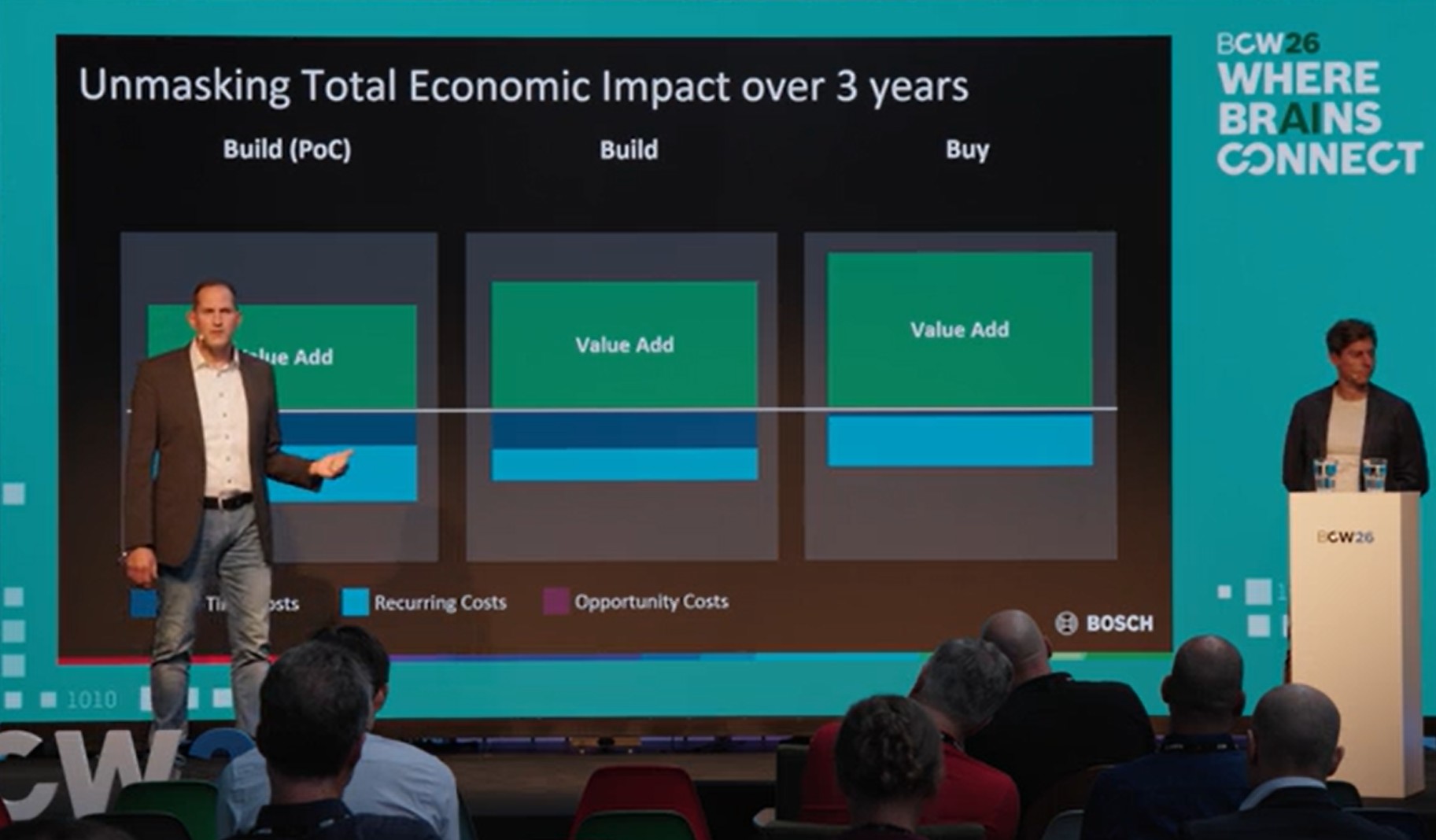
Experience from manufacturing deployments indicates that companies can achieve up to 25 percent higher value creation while reducing overall operating costs by around 20 percent compared with internally developed solutions.
The discussion is therefore not about whether companies can build AI agents.
Most certainly can.
The more important question is whether building an AI platform represents the best use of engineering capacity, investment capital, and management attention.
When organizations evaluate only development costs, building often appears attractive.
When they consider maintenance, operations, compliance, scalability, support, and time to value, the business case frequently shifts toward buying.
The most successful AI initiatives are not necessarily the most technically sophisticated.
They are the initiatives that create measurable business value quickly and continue delivering that value over the long term.
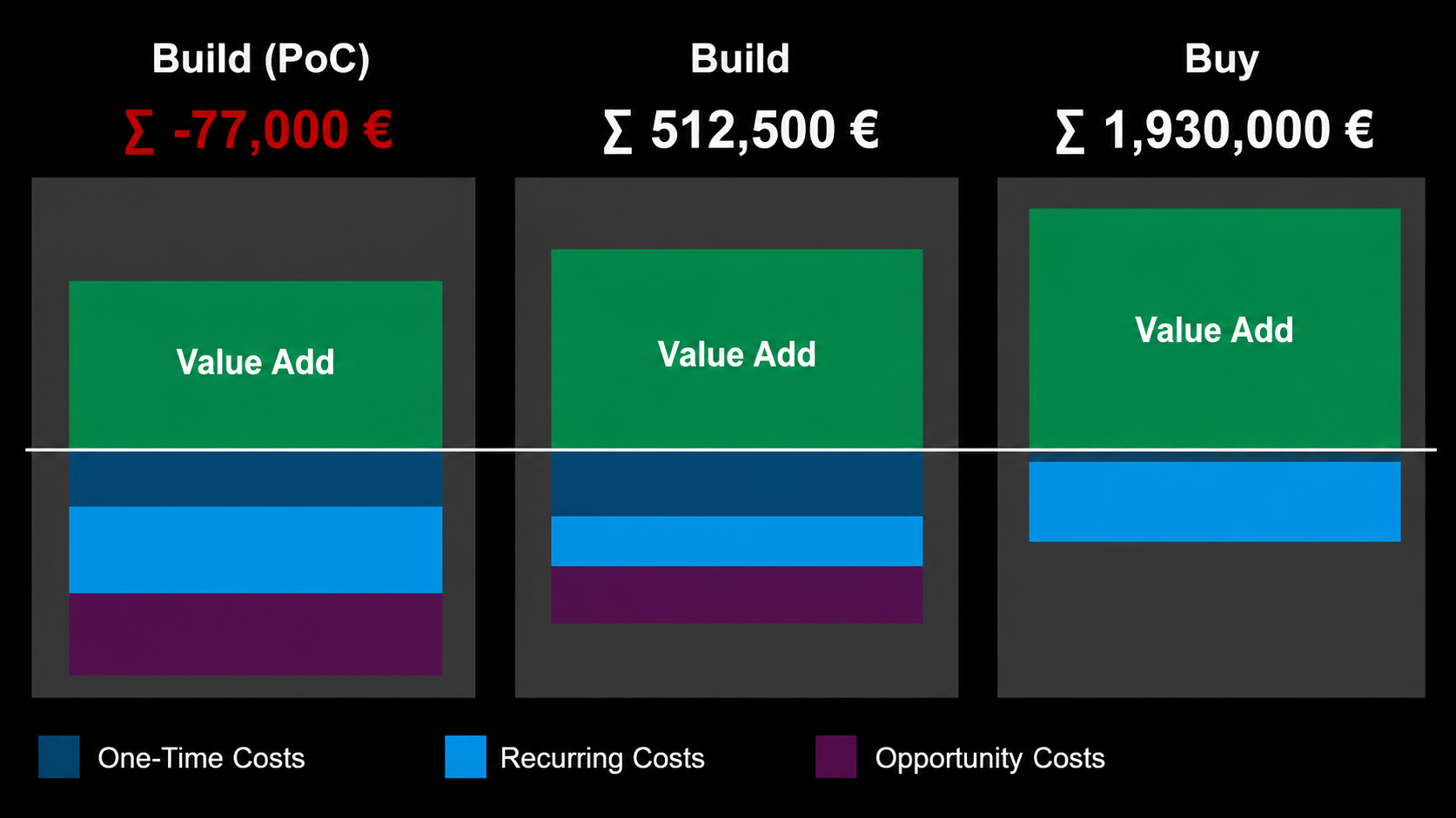
Total Economic Impact over Three Years
Summarize the economic comparison of Build, Build as a Proof of Concept, and Buy by highlighting implementation costs, recurring costs, opportunity costs, and overall business value.
Before launching your next AI initiative, ask one simple question.
Are you evaluating the full cost of building, or only the visible part?
The answer may fundamentally change your AI strategy.
Interested in learning more?
Watch our presentation on the economic impact of AI agents in manufacturing. The video provides practical insights and real-world examples to help you make informed Make or Buy decisions.