It is late on a Friday night when a critical production line suddenly grinds to a halt. The lead maintenance specialist has already left for the weekend, and the information needed to solve the issue is scattered across multiple siloed IT systems. The operators know they encountered a similar glitch a few months ago, but nobody can recall where the solution was documented. Every minute that passes increases production losses, delays deliveries, and puts immense pressure on the team.
Manufacturing Challenges
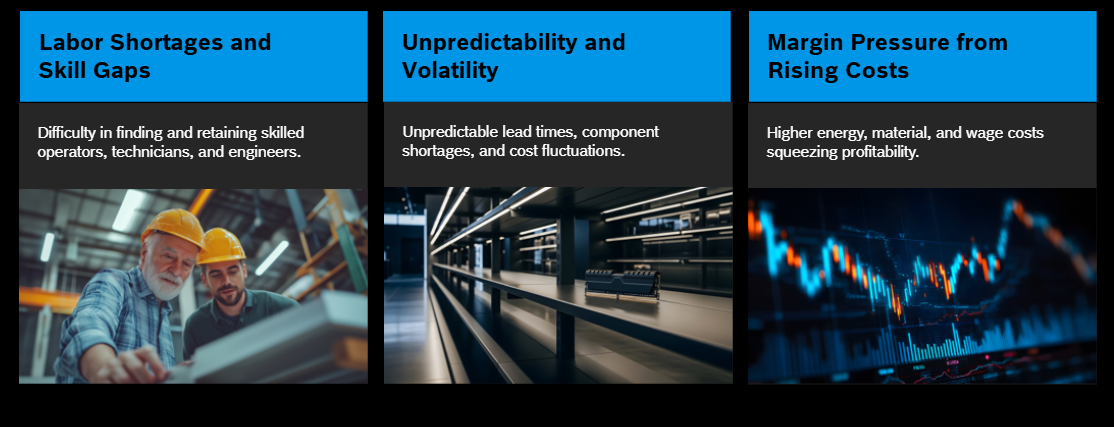
Introduce the business context with the three major challenges manufacturers face today: rising costs, supply chain volatility, and labor shortages.
Scenarios like this explain why artificial intelligence (AI) have become one of the most discussed technologies in industrial production. They promise to empower shopfloor operators with instant access to technical documentation, historical incident logs, and expert knowledge. This enables them to resolve issues in seconds, minimize downtime, and make better decisions directly at the machine.
With the rapid evolution of Generative AI, the conversation has shifted. Just a few years ago, manufacturers wondered whether AI could deliver any measurable value on the shopfloor. Today, that question has been answered. Forward-thinking companies are now focusing on how to integrate AI into daily operations and, more importantly, how to scale successful pilots into enterprise-wide capabilities across entire production networks.
This leads to a critical strategic decision that manufacturers must face today: Should we build our own custom AI platform from scratch, or buy a solution purpose-built for industrial environments?
1. Economics: The Real Challenge Begins After the Pilot
At first glance, building in-house looks highly attractive. Powerful open-source foundation models are readily available, development frameworks are increasingly mature, and many manufacturers already employ talented software engineers and data scientists. Developing a first Proof of Concept (PoC), such as a basic chatbot connected to a standard API, can often be achieved in just a few weeks.
However, this is where many build-versus-buy discussions fall into a trap. A successful pilot only proves that an AI can solve a specific operational problem in a controlled environment. It says almost nothing about whether that solution can survive the harsh realities of daily, global manufacturing operations.
The true economics of industrial AI only reveal themselves after the pilot. Once the initial excitement fades, manufacturers are confronted with tough operational and AI-specific challenges:
- Reliable and Trustworthy AI: How do we ensure that AI provides accurate, traceable, and reliable answers on the shopfloor? This requires much more than connecting an LLM to company documents. It involves retrieval pipelines, grounding mechanisms, evaluation frameworks, guardrails, and continuous validation to minimize hallucinations and ensure responses are based on verified factory knowledge.
- Data Security and IP Protection: How do we guarantee that sensitive production data, machine information, and proprietary process knowledge remain protected and comply with corporate security and regulatory requirements, regardless of whether the solution runs in the cloud, on-premises, or at the edge?
- Identity and Access Management: How do we ensure that every employee only accesses the information they are authorized to see? Enterprise AI requires seamless integration with existing identity providers, role-based access control, and document-level permissions across multiple data sources.
- The true cost of AI is rarely determined by the effort required to build the first application. Instead, it is determined by how efficiently every subsequent use case can be deployed, maintained, and operated across the entire manufacturing network. If every new application builds on a shared, robust foundation, the value of the platform increases exponentially. If not, the ongoing maintenance costs of fragmented point solutions will quickly consume the business value. This central economic hurdle is scalability.
2. Scaling: Where the Financial Equation Shifts
Deploying an AI agent at a single workstation is relatively straightforward. Rolling out that same solution globally across multiple plants is highly complex. Every factory brings its own local languages, safety regulations, and heterogeneous machine landscapes.
Furthermore, AI technology is evolving at breakneck speed. A state-of-the-art Large Language Model (LLM) today might be obsolete in six months, replaced by more efficient and cost-effective models.
At this stage, manufacturers realize they are no longer just building a simple AI app, but they are operating a highly complex software platform. Unlike a single project, a platform is never finished. It must be continuously monitored, secured, and updated.
Successful scaling requires:
- Model Agnosticism: The flexibility to adopt new foundation models as they emerge without requiring customers to redesign their applications or workflows.
- Centralized Platform Operations: A centrally managed SaaS platform that continuously delivers security updates, new capabilities, performance improvements, and model upgrades across all customers without disrupting operations.
- Enterprise Integration: Standardized integration with enterprise systems and manufacturing data sources, enabling new AI use cases to be deployed consistently across plants while minimizing implementation effort.
Unfortunately, many in-house initiatives develop in the opposite direction. Companies end up building a fragmented landscape of isolated point solutions. Every new use case introduces its own data pipelines, custom APIs, and infrastructure components. As a result, engineering teams spend more time patching and maintaining IT infrastructure than actually optimizing manufacturing processes. This creeping complexity directly impacts the business case.
3. Business Value: Looking Beyond Initial Development Costs
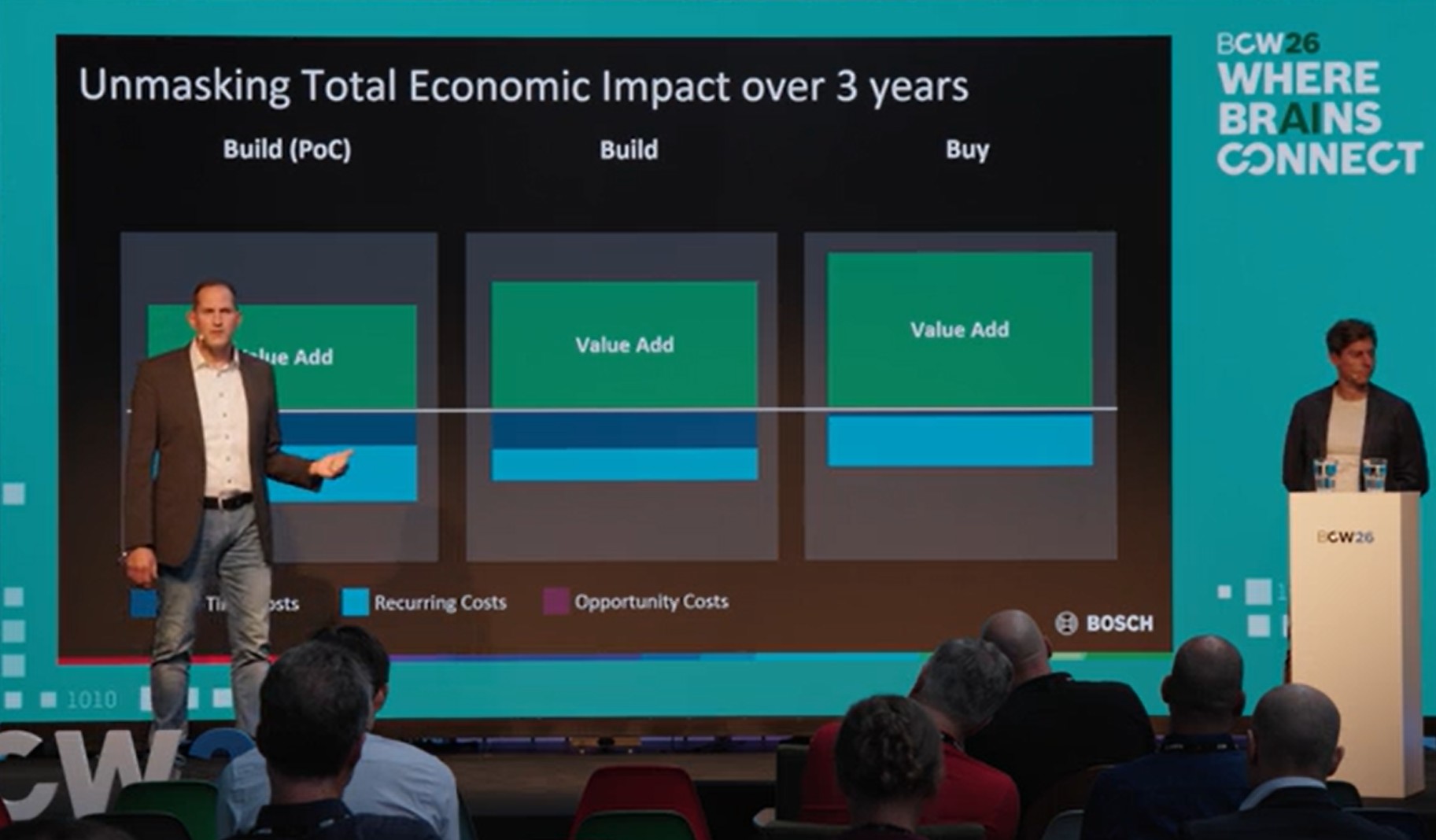
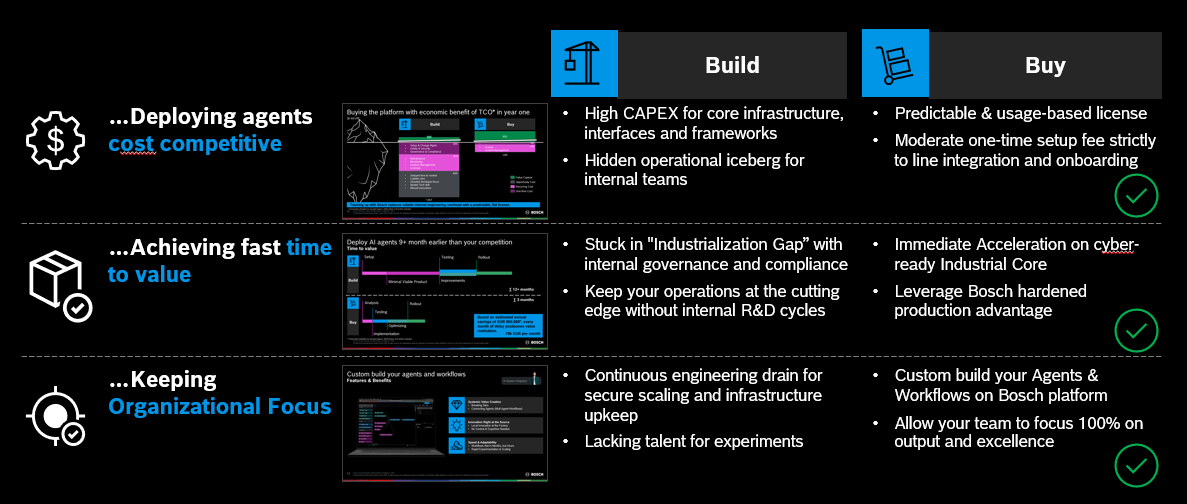
Traditional budgets often focus solely on the visible upfront development costs while ignoring the long-term operational and scaling expenses (including API tokens, vector database licensing, and continuous model monitoring). A realistic cost comparison for a plant with approximately 2,000 employees highlights the stark financial contrast:
- Build (In-House): An internally developed solution generates an annual value of around €595,000. However, this is offset by annual implementation and operating costs of approximately €710,000. The result is a net loss of €115,000 per year, as the ongoing costs for maintenance, model updates, and specialized personnel exceed the value created.
- Buy (Purpose-Built Platform): A dedicated manufacturing AI platform generates a higher annual value of approximately €850,000 due to pre-built, optimized workflows. The annual costs are significantly lower, at around €240,000 (which includes continuous model updates and security patches managed by the vendor). This results in a clear net profit of €610,000 per year.
Buying the Platform Delivers Economic Benefit of Total Cost of Ownership in Year One [in kEUR]
Predictable flat-rate license instead of unpredictable development costs
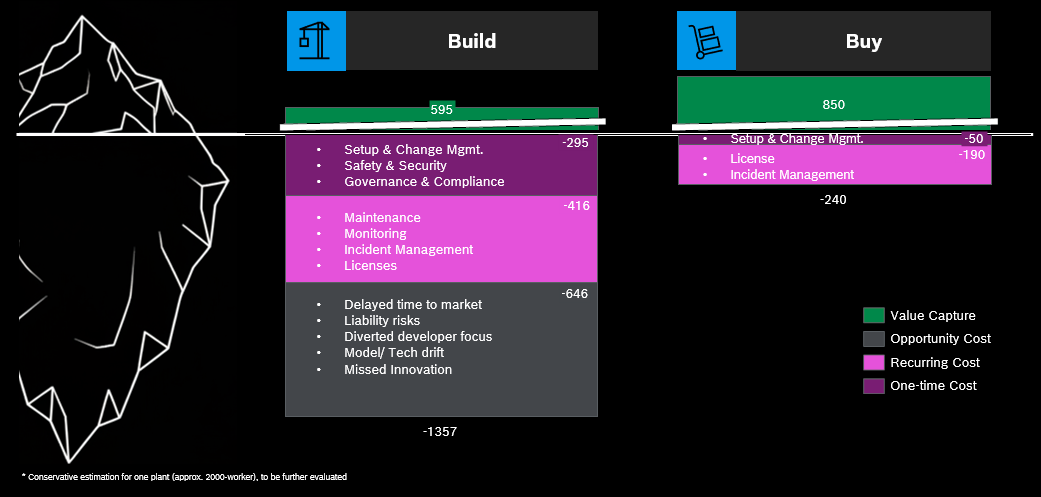
The financial implication is massive: Choosing a ready-to-use platform does not just lead to a profitable operation, but it outperforms the in-house build by more than €725,000 per year while dramatically lowering technical risk.
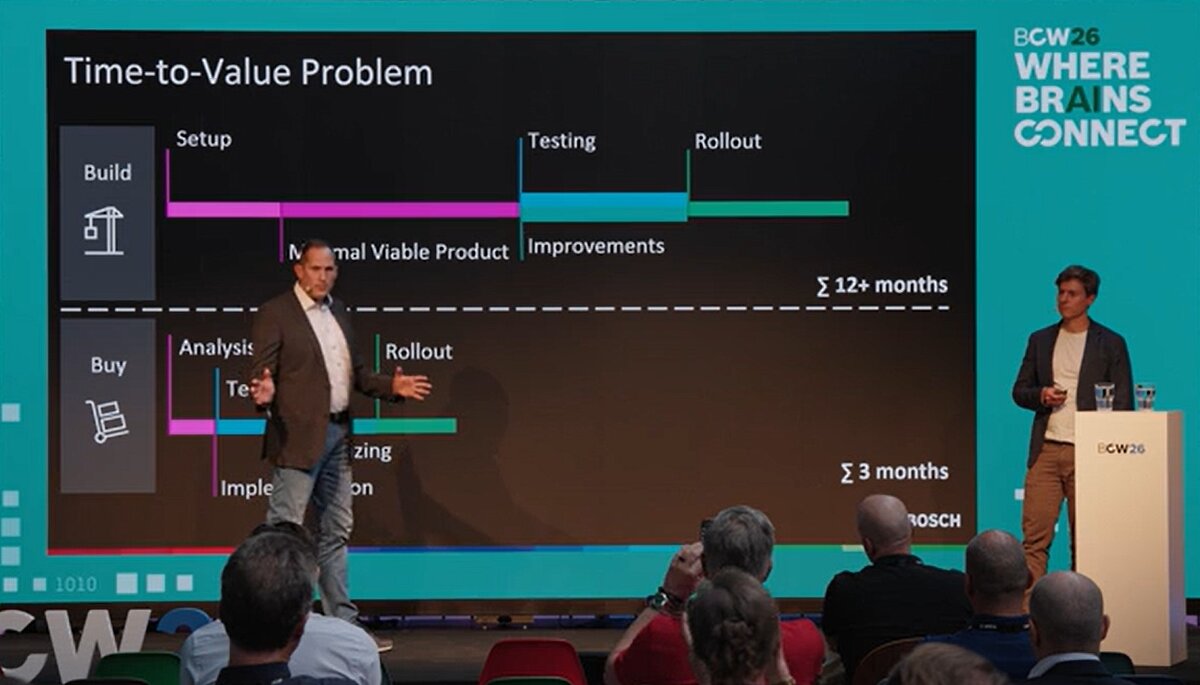
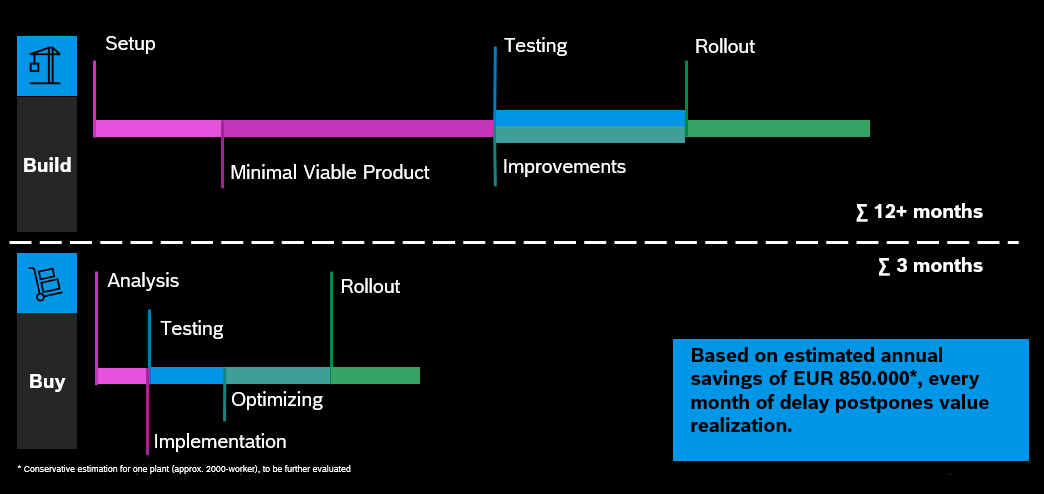
Additionally, there are substantial opportunity costs to consider. Building an enterprise-grade platform in-house (including robust RAG pipelines and enterprise security) typically takes twelve months or longer. A purpose-built platform can be fully deployed in about three months. This nine-month time difference represents nine additional months of unmitigated downtime and lost efficiency, which means potential savings of up to €637,500 that are left on the table.
Time to Value: Deploy AI Agents 9+ Months Ahead of the Competition
While you're still building, your competitors are already learning, winning, and scaling.
4. Engineering Capacity: Keeping Engineers Focused on Production
Ultimately, the build-versus-buy decision is not just a technology debate. It is a strategic question of resource allocation: Where do your engineers create the most competitive advantage?
Building and maintaining an enterprise-grade AI platform requires continuous investment in security, governance, model lifecycle management, system integrations, and platform operations. While these capabilities are essential, they do not differentiate a manufacturer in the marketplace. No customer buys a product because the manufacturer built its own AI platform. They buy because the manufacturer delivers superior products, quality, and operational excellence.
Manufacturers compete on operational excellence, product quality, and delivery reliability. A turn-key AI platform removes the burden of managing complex software infrastructure. Your engineering teams can focus 100% of their energy on high-value tasks: designing custom use cases, optimizing prompts for specific machines, and improving the actual production processes. The true, long-term business value lies in this shift from managing IT infrastructure to leveraging domain expertise.
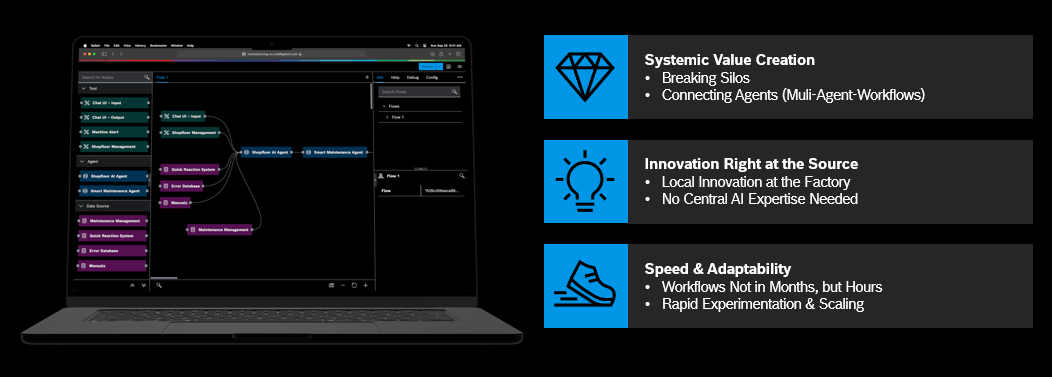
Build Custom AI Workflows in Hours, Not Months
Empower your domain experts to innovate at the source and respond to new challenges without waiting on central AI teams.
Conclusion: Why "Building Your Own" is a Costly Trap
The debate around AI in manufacturing has fundamentally matured. It is no longer about whether AI can deliver value, but how fast and how efficiently that value can be scaled across the global production network.
The financial metrics present an undeniable case:
Build: An annual net loss of €115,000 driven by high maintenance, integration, and model lifecycle costs.
Buy: An annual net profit of €610,000 secured by a proven, future-proof, and immediately deployable platform.
This direct economic advantage of €725,000 per year in favor of buying is further multiplied by the nine-month time-to-value advantage during implementation.
For manufacturers, the key to success is not reinventing the software wheel. The winners of the industrial AI transformation will not be those who write the most code, but those who deploy their valuable engineering talent where it matters most: on the factory floor, optimizing production, and building smarter factories.
Building AI Agents Isn't the Hard Part. Operating Them Is.
Why the real challenge lies in running your AI solutions securely, reliably, and at scale over the long term.
Interested in Learning More?
Watch our presentation on the economic impact of AI agents in manufacturing. The video provides practical insights and real-world examples to help you make informed Make or Buy decisions.